First of all, we haven't always welcomed immigrants.
-Samuel P. Huntington
-Samuel P. Huntington
This post, How to meet multicultural customers, is specially for my BF-student Lema. She is working with her theses and her topic is: how social workers face(?) their multicultural customers. On this post there is some suggestions for theory part of her research.
Maybe Geert Hofstede's: Dimensions of national cultures is one of the basic idea for your research as we discussed. Definition of the culture is the first thing. (In other words: What do you mean about culture in your current research. How do you define Finnish culture and how do you define the opposite culture you are comparing to it.)
Geert Jan Hofstede: Cross-Cultural Dimensions
• Power Distance
• Individualism
• Masculinity
• Uncertainty Avoidance
• Long-Term Orientation (Links for further information.)
• Individualism
• Masculinity
• Uncertainty Avoidance
• Long-Term Orientation (Links for further information.)
Geert Jan Hofstede: The cultural biology of organization (link)
Apocalypse How there are some words that may be useful/you can get some ideas via them
Rathbone, J.P. (2011). Revolting middle classes eclipse clash of civilisations. Financial Times
On this blog I have a published post by name: Shalom Schwartz-the content and structure of values. I suggest that there is a big question of values behind your topic? Urie Bronfenbrenner and his Ecological Theory is my favorite one.
Publications of Urie Bronfenbrenner:
- 1972. Two Worlds of Childhood. Simon & Schuster. ISBN 0-671-21238-9
- Two Worlds of Childhood: US and USSR. Penguin (paperback, 1975). ISBN 0-14-081104-4
- 1973. Influencing Human Development. Holt, R & W. ISBN 0-03-089176-0
- 1975. Influences on Human Development. Holt, R & W. ISBN 0-03-089413-1
- 1979. The Ecology of Human Development: Experiments by Nature and Design. Cambridge, MA: Harvard University Press. ISBN 0-674-22457-4 (be familiar with this and terms like: microsystem, mesosystem, exosystem and macrosystem. Here is a link for one PDF)
- 1981. On Making Human Beings Human. Sage Publications Inc. ISBN 0-7619-2711-3
- 1996. The State of Americans: This Generation and the Next. New York: Free Press. ISBN 0-684-82336-5. Lony Tunes
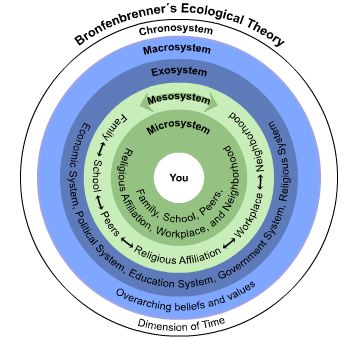
Read also J.N. Nielsen's text: The second Law of Geopolitical Thought. I'm familiar with Urie Bronfenbrenner's theory, this text is in Finnish but you can find out a lot of links in English.
This can maybe help you a little bit: The article "The Clash of Civilizations?" by Samuel P. Huntington is an
intriguing view on how modern day civilizations have grown to become
cultural and economic entities trying to make new identities for
themselves."(See source here). Samuel P. Huntington is a researcher that you maybe become familiar within your research.
- Huntington, Samuel P., The Clash of Civilizations?, in "Foreign Affairs", vol. 72, no. 3, Summer 1993, pp. 22–49. (See the also JSTOR)
- Huntington, Samuel P., The Clash of Civilizations and the Remaking of World Order, New York, Simon & Schuster, 1996 ISBN 0-684-84441-9
- Huntington, Samuel P. (ed.), The Clash of Civilizations?: The Debate, New York, Foreign Affairs, 1996 ISBN 0-87609-164-8
Quotes by Samuel P. Huntington
Documents similar to SPH "The Clash of Civilizations"
Crokatt Rickhard: ANTI-AMERICANISM AND THE CLASH OF CIVILIZATIONS (https)
Maybe a book written by Brenda Shaffer: The limits of culture: Islam and foreign policy is also very helpful for you. Something about her other publications can be found out on Wikipedia:
Books
- Author of "Partners in Need: The Strategic Relationship of Russia and Iran" (the Washington Institute for Near East Policy).
- Author of "Borders and Brethren: Iran and the Challenge of Azerbaijani Identity" (MIT Press, 2002).
- Editor of "The Limits of Culture: Islam and Foreign Policy" (MIT Press, 2006).
- Author of "Energy Politics" (University of Pennsylvania Press, 2009).
- “Iran’s Internal Azerbaijani Challenge: Implications for Policy in the Caucasus,” in Moshe Gammer (ed.), The Caucasus (London: Frank Cass, 2004).
- “U.S. Policy in the South Caucasus,” in Dov Lynch (ed.) The South Caucasus: a challenge for the EU (Chaillot Paper 65, EU ISS, December 2003).
- “Azerbaijan” in Waisman and Vasserman (ed.), Political Organizations in Central Asia and Azerbaijan: Sources and Documents (London: Frank Cass, 2003).
- “Azerbaycan Cumhuryetinin Kurulusu: Iran’daki Azeriler Uzerinde Etkisi”, in Emine Gursoy-Naskali and Erdal Sahin (eds.) Turk Cumhuriyetleri (Amsterdam/Istanbul, SOTA Publications, 2002)(in Turkish).
- “Postscript” in David Menashri (ed.), Central Asia Meets the Middle East (London: Frank Cass, 1998).
Yahya M. Sadowski The myth of global chaos. Google-books.
And last but not the least there is a three circles model that is a very useful model for many different contexts.

How to utilize this model as a tool within your research?
e.g. such as
1 Finnish culture values (?)
2 comparison culture values
3 social workers values
etc.
Kimmo Ketola's research Suomalaisten arvot ja uskonnollisuus is maybe interesting/helpful for you.
Dimensions of national cultures. (Google scholar). (8.11.2016)
(Edit 8.11.2016)
Comments